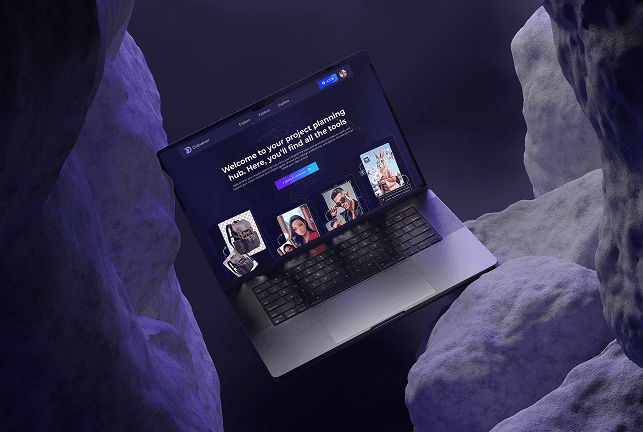
Drawever — AI Tools Platform
Overview
Drawever is an AI-powered creative platform that I co-founded and led all design for from day one. The platform offers a versatile suite of AI tools aimed at streamlining creative workflows, boosting productivity, and helping creators generate high-quality outputs faster.
50,000 creators use Drawever today. Bounce rate: 39.6%. Conversion lift: 22%. These numbers weren't achieved through visual polish alone — they came from deep listening and behavioral thinking.
The Challenge
AI tools were everywhere, but most felt overwhelming or gimmicky. Creators needed something that felt intuitive — a platform that reduced complexity rather than adding to it. The challenge was to design an interface that made powerful AI feel approachable, even to non-technical users.
My Role
As co-founder and lead designer, I was responsible for the entire design lifecycle — from initial research and wireframing to high-fidelity UI, prototyping, and design system creation. I worked closely with the development team and sat with real users to understand their workflows.
Approach
Research-first design
We started by interviewing creators across different skill levels — from professional designers to hobbyists. The key insight: users didn't want another tool to learn. They wanted AI to fit into their existing workflow, not the other way around.
Behavioral psychology at the core
Every layout decision was backed by a psychological reason. We used progressive disclosure to avoid overwhelming users. We leveraged recognition over recall by surfacing relevant tools contextually. We designed feedback loops that made users feel in control of the AI, not the other way around.
Iterative prototyping
We tested early and often. Low-fidelity prototypes helped us validate concepts before investing in high-fidelity designs. Each iteration brought us closer to a product that felt effortless.